picking up the thread
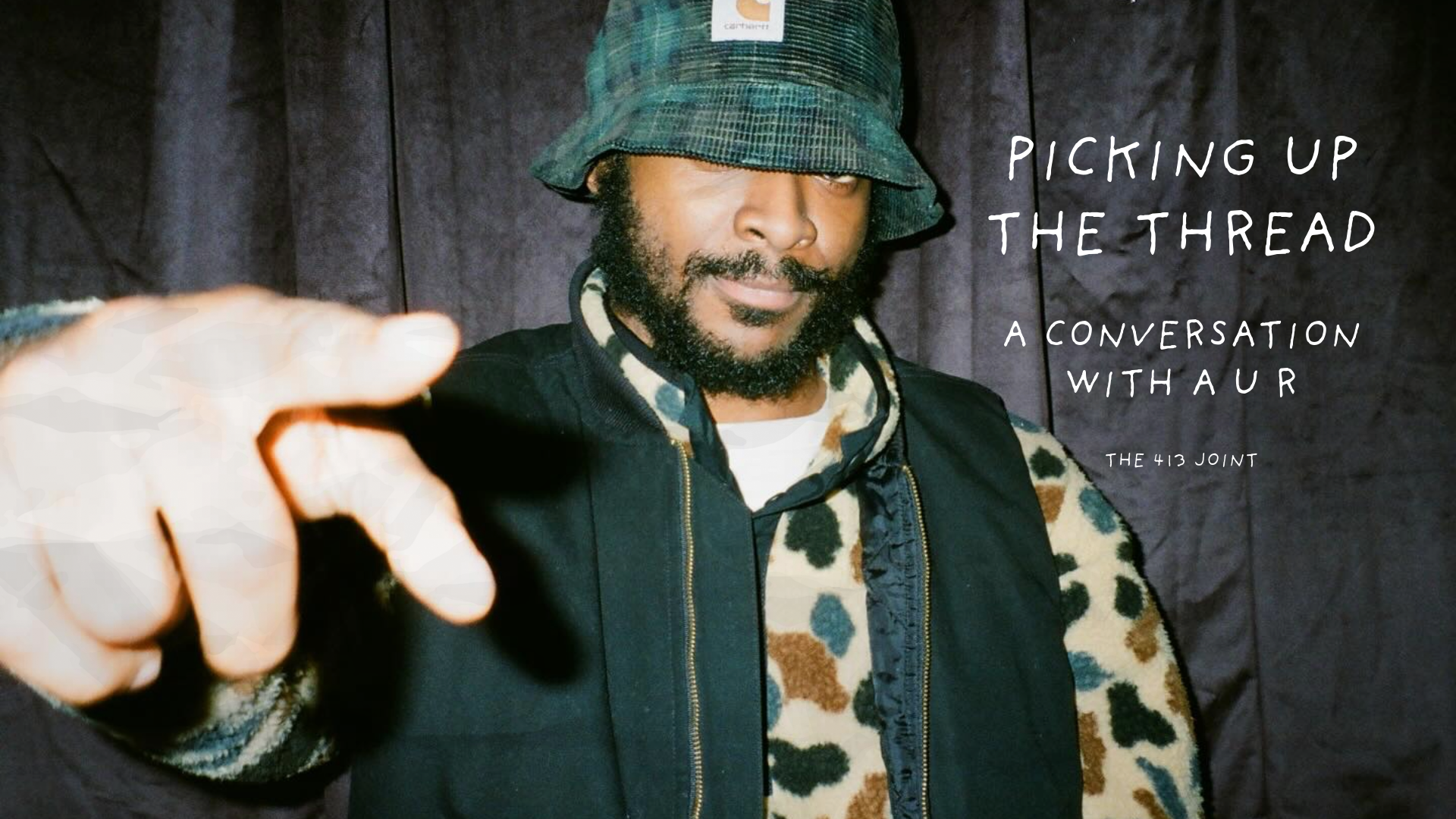
Returning to The Carhartt Connoisseur, real life in the music, and the worlds built around the beat.
Timing is everything.
The last time The 413 Joint spoke with artist A U R, the conversation centered around his 2021 release, The Carhartt Connoisseur. The project pointed the creative artist in a new direction, introducing the impressive producer as an exuberant rapper.
While not a full rap project, the album opened up the world of A U R with our first official look at his playful yet self-assured voice. Like watching Bob Ross build a world in front of us out of happy accidents, it is truly a joy to listen to A U R’s world come together through texture, humor, and niche references.
When I think of A U R, I think of the joy of getting lost. I think of finding myself in the art made while feeling their beats run through me.
Returning to converse with the artist almost five years later, A U R has released multiple more projects, including the full rap project The A U R Experience. The timing feels right. Opening the door again reveals that the thread never stopped. The worlds continued to form, the vision became more aligned, and the voice got sharper.
We touch on what world-building means, goals for the artist moving forward, including their upcoming project The Temptation of Saint Anthony, and the many hats worn by the Carhartt Connoisseur himself.
413: The first time we talked, The Carhartt Connoisseur had just dropped. We spoke about how it wasn’t intentionally a rap album — it had raps, it had beats, but it wasn’t forced. Since then, you’ve released more solo rap work. What does your process look like now when you’re building and releasing a project?
A U R: Yeah. So now, as of recent, I dropped another solo project, all full raps. My formula has kind of been, in between my projects and my collaborations with other people, I accumulate beats either for myself or from other producers, and I’ll stack up lyrics.
I usually have lyrics already written down from the past, or I’ll listen to something a thousand times. Then it’s like, okay, I’ll stack it up from there.
Once I get one song that’s kind of like the nucleus of it — not really the intro or the ending, but just when I’m like, okay, I got a concept. I have something that I could go off of. Then I go off of that.
So I try not to force it. I won’t just drop random stuff. I’ll wait until I have a whole idea, a cohesive project. Then it’s like, okay, now I’m ready.
I dropped The Carhartt Connoisseur right when we were talking. Then my next one was The A U R Experience. And now, coming back, I’m gearing up to drop my next one, probably within the next couple months.
413: In the old interview, you said, “everything I say is real life.” Does that still feel like the center of your work, or has your relationship to what you share in the music changed over time?
A U R: That’s a good question.
I would say, yeah, it’s still real. I was just talking with my friends about this too. I try to make it all come from me, from a personable place, so it doesn’t sound replicated or like anybody else.
Pretty much everything I’m saying is true. Of course, it’s an art form, so I’m still trying to exaggerate or say things in a crazy kind of way.
But yeah, for the most part, I’m just saying everything truth from the heart. I’m not saying any made-up things unless it’s a story that I’m trying to tell or something, you know?
413: Your music always feels like it exists in specific worlds — the clothes, the food, the smoke, the references, the people around it. When you’re building that world, how much of it is seeing versus feeling? Do you picture it first, or do you feel your way into it?
A U R: It’s a little bit of both. It’s different each time.
With The Carhartt Connoisseur, that emerged first as me. I felt it. I had a vision like, okay, I wear the Carhartt and things like that, and I want to put that in the forefront. I’m just gonna work around that.
So I kind of leaned into it more after I had the foresight.
It works like that, but a lot of times it’s different things. For The A U R Experience, I had the idea, but I didn’t really put it into motion yet until I started doing shows. I started getting the energy back from people.
Then I guess it was time to put something out and lean into it more.
413: You mentioned getting energy from live shows, and one of the themes I’ve been thinking about is how your art fed my art. I listened to a lot of your beats while making The 413 Joint. What is one way art feeds you?
A U R: Yeah, that’s a good question as well.
It literally gives me — not to say I don’t have motivation myself — but it’s like fuel to the fire. It’s like if you’re driving a car already fast, then you hit the NOS on it. It’s just like an extra boost.
You’re chilling, you’re making music here and there and it’s good, but you don’t really have the maximum amount of energy you have.
Then it’s like, okay, I go out and I see a show, or I go to the studio, or I go to an art show and see people perform. Everybody is putting their whole being into the art, you know?
If it’s performing, or an art show where people are making sculptures, it’s like, oh, okay, this person is putting their all into it.
For some odd reason, that helps me out a lot. It’s like, okay, dang, I need to be doing what I know that I can do as well, so I can be in these predicaments that I would like to be in.
413: Previously, you said, “I don’t have a destination. My sound is universal.” Do you still feel that way, or has the music started moving toward something more intentional?
A U R: I’m still trying to be open-ended because I’m still trying to get better.
I would say the destination is, I guess, to get better, but that’s a never-ending thing. I just want to get better in all facets.
If I know the music is nice and the raps are good, it’s like, okay, now I want to market it better and have a show and do this. It’s different avenues and many ways that I feel like I could always progress.
So I try to leave it open-ended, but I don’t want to not have a goal in mind.
413: Would you say putting on your own show is one of the goals now?
A U R: I have been doing a lot of shows, but I would say a goal that would be in mind would be to have my own show.
Like, possibly, I put it on. I’m on the show. I’m gathering people, you know what I’m saying? Things like that and growing it. That would probably be a goal of mine.
413: What does an A U R beat look like to you?
A U R: That’s a good one. That’s a good one.
Personally, I feel like I have a couple genres of beats. I feel like you can break beats up into maybe three different categories.
I have some beats that look like they can be a nice sunny day out on the beach or out on an island, you know? Those type of beats that are beautiful and nice.
And I have another kind of genre of beats that are spooky. They’re those type of beats that make you feel like it’s Halloween kind of, whenever you listen to it.
And then I have some that are kind of just chill, chill jazz beats to study to.
So I feel like those are my three genres. Going back to your original question, the first one would be like a sunny day. The second one would be like a stormy, stormy night. And the third one would be like rain, mountain rain or something.
413: You always have a lot of references in your work. Is there anything specific shaping the next project?
A U R: For this upcoming album, it’s going to be heavily based on art.
My last couple projects, I’ve been making the art and using it as cover art for my beat tapes.
My next beat tape actually is like a rendition that I’m going to create of a picture of The Last Supper. It doesn’t quite make sense now, but when you see it, you’ll understand.
And then it’s basically going to lead right into my third upcoming album, which is biblically titled as well.
I’m not really a religious person. Growing up, I never went to church. Nothing like that. But it’s more so tied to the art of the time. So like the drawings from The Last Supper, like the Renaissance drawings, or things of that sort.
I kind of got reference from those paintings, like Da Vinci and things of that sort. I’m going to be taking it a different way.
I’m not going to be really referencing the Bible, but it’s just about the art and the virtuosity that they put into it, making it.
413: Simply: why Carhartt? What about it spoke to your soul?
A U R: Initially it wasn’t something that spoke to my soul.
I used to always try to have a different sense of style. So I would go thrifting. One time I went thrifting and it was just a whole bunch of Carhartt shirts. And I just got all of them.
It probably was like a good ten of them. I don’t know what happened, but I probably was about eighth grade. Nobody was really wearing it like that. So I just wore it all throughout those years.
Eventually, I would go to events, and for my outfits, that’s what I would wear. I would just wear all Carhartt.
Then I got older. I tried to make it look more stylish, and then it kind of just caught on.
People see me, they’re like, “oh, where’s your Carhartt at?” So it kind of just caught on and it took a life of its own.
I perpetuated it a little bit by wearing it so often. But it wasn’t really like, oh, I’m gonna wear this and I’m gonna make it my thing.
It just happened to be that way because that’s what I wear, you know? I wear other things as well. That kind of just caught on.
So yeah, I literally had people stop me like, “hey, you’re the Carhartt guy, right?” And I’m like, “well, yeah, I guess if you say so.”
I’ve had people give me Carhartt to sign, cards to sign, things. I’m like, what the heck? Some guy tried to buy my bucket hat. I was like, yeah. It’s crazy.
413: You mentioned wanting to stand out through style. How has that grown from the earlier era to now?
A U R: Yeah, it’s definitely grown.
Starting out, I just wanted to be the producer in the back. So I would kind of just do my thing, wear my plain clothes, and then I’d just be off to the back. I had a more reserved kind of style.
But then, as I was leaning more into it — I mean, I always got fly. I’m not going to say that. But I just did it in different ways.
As I leaned more into it, I started acquiring more big colorful jackets, or big giant fuzzy Carhartt hats, or things like that.
Because people see me, or people see me and Jalen and everybody, it’s like we all trying to get fly, you know?
Literally, when we’re on the phone, we be asking something like, “all right, how fly is everybody getting?”
Because if somebody is performing and they’re the only one performing, it’s okay, let them get the flyest. But if everybody’s all performing, everybody’s all coming. And like, okay, everybody’s turning up to a ten.
You don’t want to be the odd person out the group.
413: In the old piece, your daughter had an influence on The Carhartt Connoisseur. How has fatherhood shaped you and the projects coming next?
A U R: Fatherhood personally is crazy because you have yourself that you’re taking care of, and of course, your girl and your kids.
So it’s like being a father, it’s like, okay, not only do you have two humans, they’re little small humans that are depending on you for everything, you know?
It’s not pressure in a bad sense, but it’s pressure in the sense of like, you know, they say the cliche like pressure makes diamonds or whatever. It’s a good way to take care of it. It’s another motivation thing.
Just like when I go to the studio or go to a show, and now I’m motivated to make the thing and say, okay, I can’t just sit.
And, you know, some people who don’t have kids or don’t have things, they can just sit in the back and just chill and watch Netflix.
Like, I gotta get up. I got soccer practice, basketball practice. I got this, that, the third.
So after that, it’s like, okay, I kind of want to chill out and create in my own way too. So it kind of gives me a little space to balance out being.
And it’s another one of those worlds too.
When people see me by myself, it’s different than if you see me with my kids. I’m like a whole totally different person. I’m on alert. I’m trying to make sure nobody gets hurt, or, you know, everybody’s safe.
So it’s just like a different thing. It gives me more things to rap about, gives me more things to think about, perspective on women, girls, all that thing.
So it’s just very helpful.
That was a look at our conversation with A U R around world-building, influences like fashion and family, and what’s coming next. Keep an eye out for the upcoming date for The Temptation of Saint Anthony, and spend some time in the world of A U R through Bandcamp, Spotify, and Apple Music.
