a conversation with james emmett
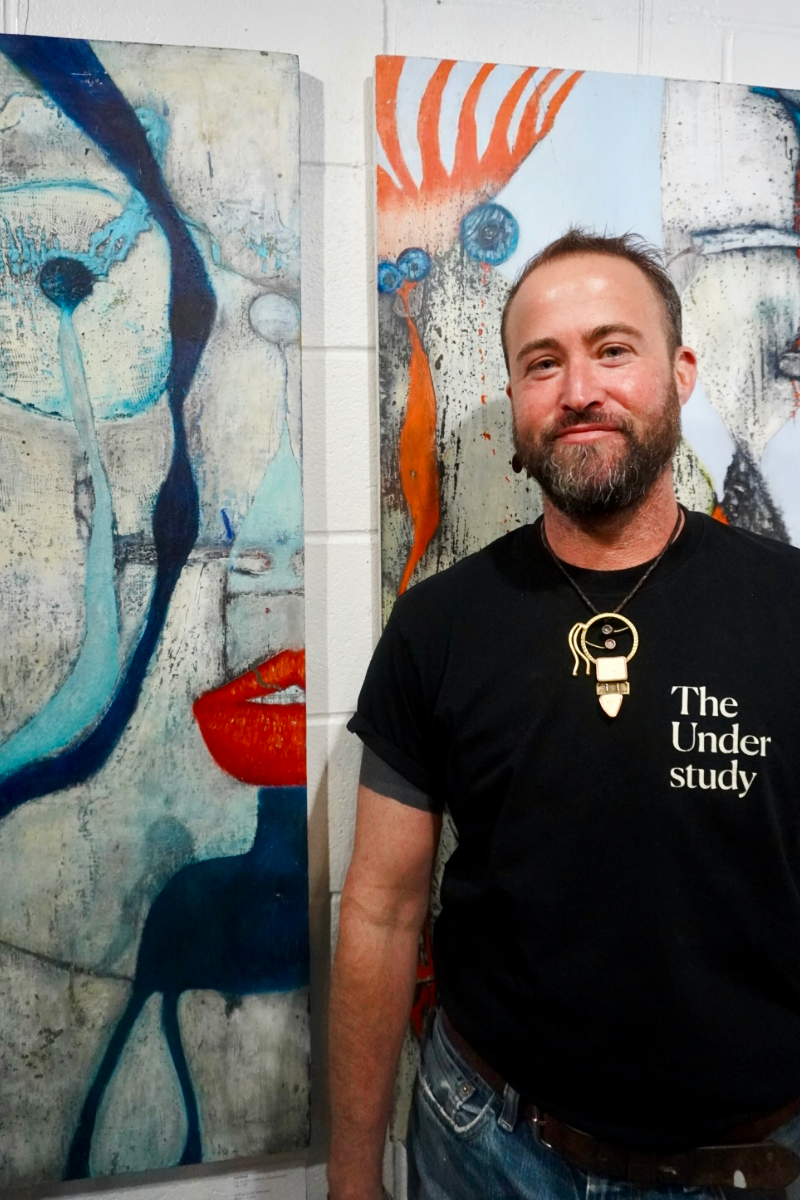
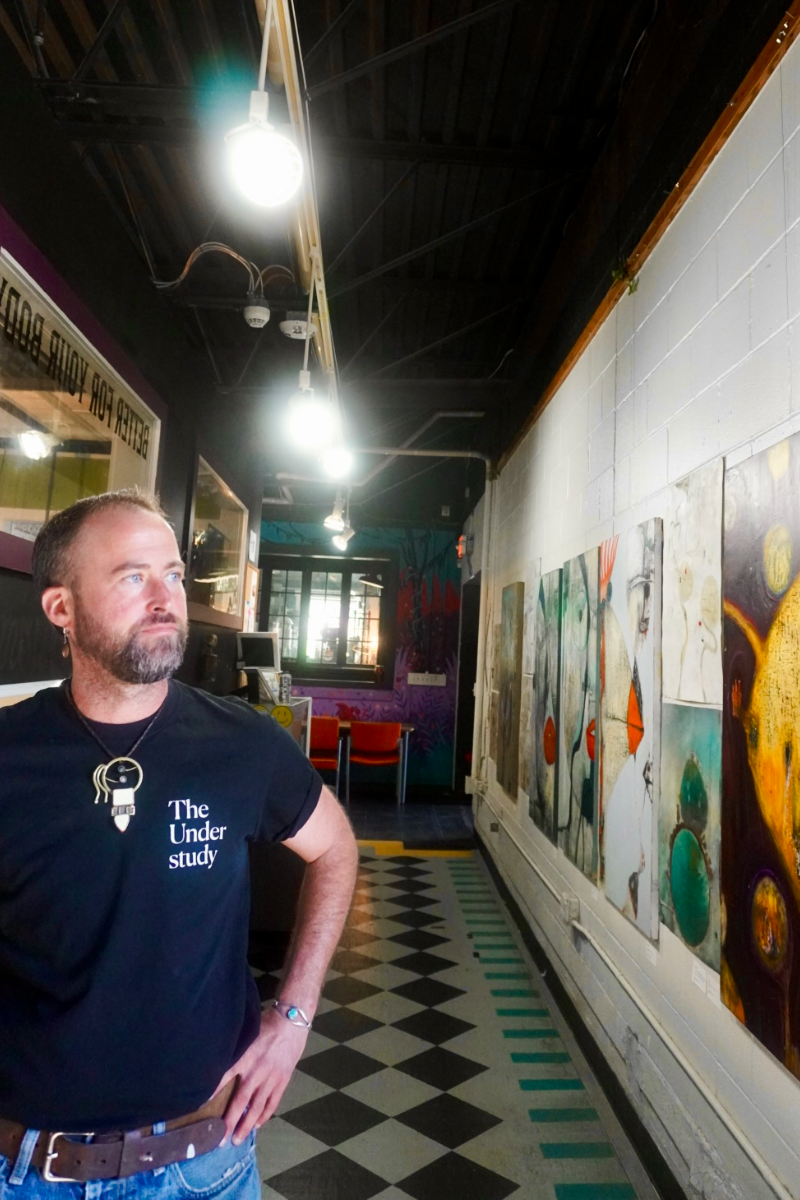
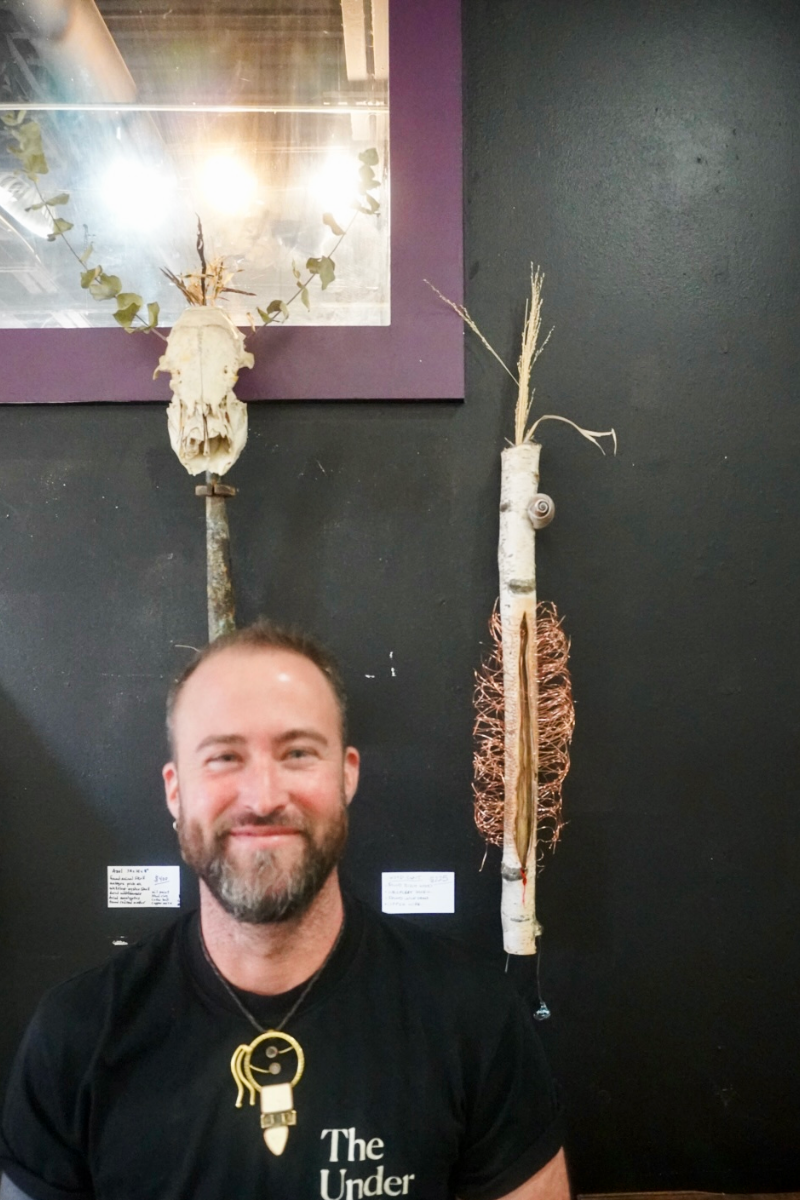
I was first introduced to James Emmett’s work while visiting the Urban Food Brood, where his paintings and sculptures are on display at the moment. I remember first feeling the energy in the work, not quite understanding what I was seeing, but feeling the life behind something still. The space’s energy has since been transformed with bodies made out of found objects, bleeding vulvas, and familiar faces under layers of paint.
Every time you go back, there’s a new detail to pick up, a new impression to leave on you, a new spark of energy to walk away with.
James is a self-described “student of life,” and his body of work includes painting, sculpting, woodworking, and writing. While the artist’s work more than speaks for itself, it was a pleasure to pick his brain over coffee at the Brood. Lightly edited for clarity.
The 413 Joint:
I know that you moved from Chicago to Western Mass. It’s probably been about a year or so.
James Emmett:
It was a year, May fifteenth.
The 413 Joint:
Okay, awesome. Talk to me a little bit. Just how you're feeling about that right now.
James Emmett:
I love it.
I lived in Chicago from 2005 until December 2024, and that's definitely my home and I still feel very attached to Chicago. It's a wonderful city. It's a Midwestern city. So it's very friendly. Definitely has issues with politics, but Chicago has a huge queer community and queer community is important to me.
Since 2019, I was growing tired of city life. The discordant sounds and hustling from here to there was messing with my nervous system and my energy stopped feeling aligned with Chicago. I was looking for a spot to live where I could still have access to culture, still have that kind of city feel, you know a little bit of bustle, but I wanted more access to nature and a lot less buildings on top of buildings.
I traveled around to find out where my body felt aligned - North Carolina, New Mexico, sussing out if my body felt good in those spots. Oh my God, I love New Mexico. Taos, Santa Fe, it’s a dream. But there was still something that didn’t match to living in those spots full time.
I have a friend that lives in Eastern Mass, and for years she had been like, “Hey, I know you want to move. If you want to take the first step here, you're more than welcome.”
My mom passed in October of 2023, and I had gotten out of a relationship at the same time and it became really clear to me that it was a resonant time to make a move. Like, “Yeah, I'm done here.” You know? Energetically, it was very, very clear.
So I called up my friend and asked if her offer was still good. It was and so I moved to Eastern Mass. I met my ex who lives in Western Mass on a visit to Eastern Mass before the move and the first time I visited her, I was like, “Oh, this is the place.” Western Mass is the place.
Since 2019, I had drawn sketches of the home and location that I was envisioning, I wrote lists of the attributes and things that I wanted in a new spot and Western Mass hit almost all of those desires. The five colleges kind of gives that city feel. There’s some access to art and tons of creative and weird folks, and I love weird, and tons of access to hiking and nature.
I really love it for the time being. And it’s also, it's a transition.
Geography and land, I think, informs us on a cellular physical level and change, even when it’s chosen and acted upon can present some challenges. It's been everything I wanted, but I left community in Chicago, trying to build a new community out here at 47 living in the Hilltowns hasn’t been seamless, and damn this past winter was rough. I was feeling a little caged in like Jack Nicholson in The Shining. I think I was presented with an opportunity to re-examine who I am now, which at my core, I'm always the same, but what are the things that are important to me now that I'm in this new space with new information, with new data coming from the land, other animal species and the people that live on that land.
Energetically, I just wasn't feeling it anymore with Chicago. And that definitely impacted my artwork and the way that I approach my creativity and that has come back online for me since moving. I've been here for a year and there's already new skin that's growing from my experiences that inform how I show up to my creative practices and what is coming out of me.
That feels like a gift to me.
For me, my creative practice is central and I'm always trying to learn how I can articulate the thing that I want to articulate, even if I don't cognitively know the thing that I'm trying to articulate. And that gap is so frustrating sometimes. And also when I get close to it, or at least when I evolve in it, it's the most rewarding thing.
The 413 Joint:
Touching on some different points there. Talk to me a little bit. One, being in this new space, a lot of the sculptures are collecting different materials, different things that you see in the world, interacting with the physical world. Are you looking for materials or are they finding you? And how much is that intentional?
James Emmett:
I mean, antiquing, going to thrift shops and going to antique shops. That's my favorite thing to do. Give me either a coffee, a tea, an alcoholic beverage and that’s my favorite thing to do.
I always love to go to second hand shops because I love to have things around me that are used. They already have a life to it. It's got that funk, you know? It's already had a lifetime, or lifetimes and that’s exciting to me.
Even though I don't know the history of that thing, there's a felt sense that I know that other hands and other lives have been with that thing and there's something that's transferred. So there's something special about that.
Sometimes I'll buy things from a shop and I'm just, “I like that.” Something about it I like. And sometimes I'll have an idea for it in a spot in my home, like, “Oh, I need this for my home.” Other times it's just nerdy shit. I just want it around. It feels good to have it around, whether it be a dollar pin or a piece of furniture.
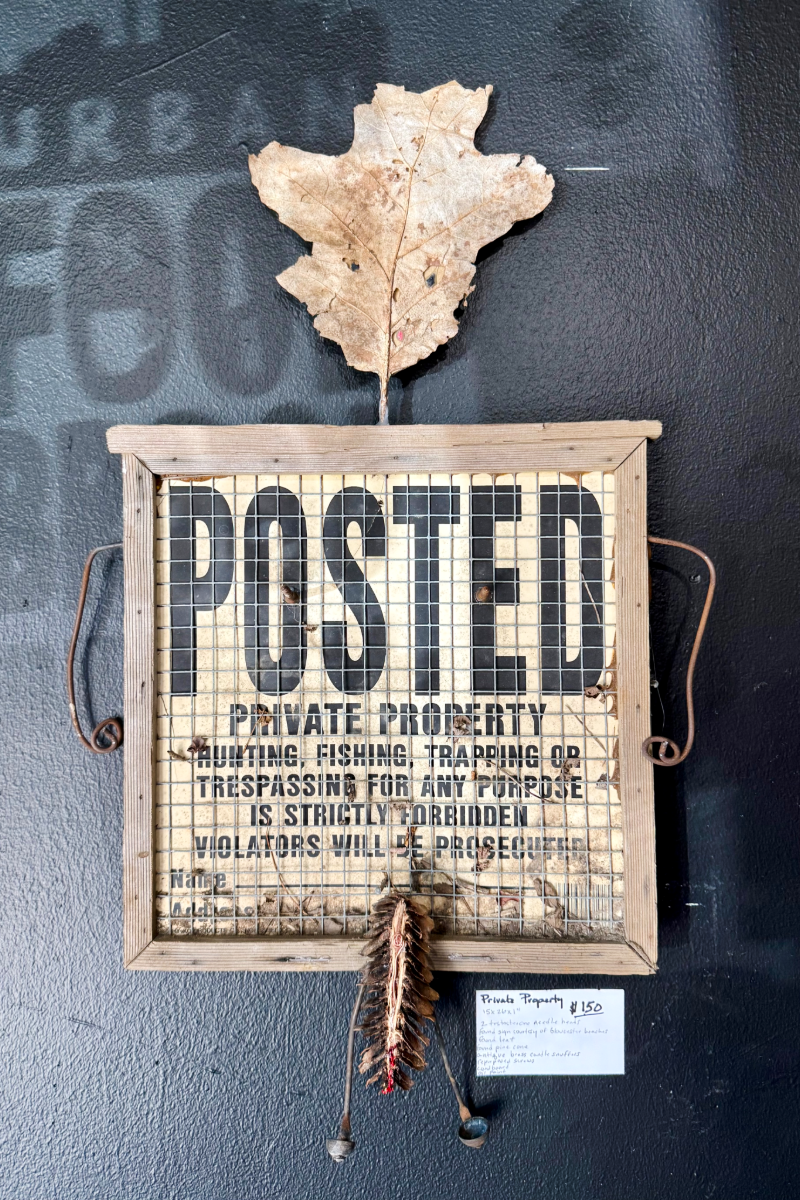
There's occasionally something that I'll see, like maybe an antique tool, that I'm like, “I know I'll use that in some way in a sculptural piece or as a tool on my paintings or to just have it around me.”
When I'm hiking or I'm just walking around, just coming to a coffee shop and see something on the sidewalk, I'm never looking for it, but it like smacks me over the head like, “Hey, take me home and do something with me.” Whether that be a dried flower or a stick, or some random trash.
When I get hit over the head like, “Hey, take me home,” sometimes I know automatically that I want to do something with that thing right away or sometimes it still needs time to find its place in an idea or piece. Often those other objects that I've gathered, whether from walks or from antique or thrift shops, it all kind of comes together around that thing that gives me the immediate spark of, “Do something with me now.”
When it’s not clear how the object wants to be used, I'll have it around my studio and pass by it like fifty million times until suddenly I look at it, and I'm like, “Oh,” this is what I’ll do with it. Clarity comes quickly sometimes and then sometimes I almost feel like I have to open up or expand my energy, or maybe find another object that will compliment and marry that object, in order to understand what to do with the object that sparks interest.
The 413 Joint:
When do you know a piece is over for you? How do you know when all that energy is finally, like you said, you came close to articulating what you wanted to?
James Emmett:
When I know it's done, not to sound pretentious, but it's not asking me for anything else. The conversation is over. Again, not to sound pretentious, but it's not asking me to solve anything.
For me, it's energetic. It's a finality.
Most of the time, finality comes to me one hundred percent with my found object sculptures. With my paintings it's really helpful if I sell them and they're not around me anymore because, sometimes I'll have pieces that I painted a year or two ago and I think they're done. And then if it's still around me in a year or two, I'll pass by it and I'll be like, “Nope, we're doing something either more or different.”
Whether that be painting over it while still showing its history in some ways and kind of working back through it.
It's all about my ability to articulate the piece. When a piece feels undone, unsatisfying, or like I took it as far as I could within that moment of my understanding and my ability, I know it’s time to put it aside and let things settle for a little bit. To just let it be and then a year passes, a year and a half passes and there’s new information and abilities that I have that want to shape it more or differently and the conversation starts again. Again, at my core, I'm not a different person, but my experiences have shaped my cellular body in a certain way. There are certain ways in which I have evolved and I am different.
So how I relate to that piece has changed, and it's like asking me for more because I can give it more.
That’s just with my painting though. Most of my found object sculpture pieces, regardless of how long it takes, there does seem to be more of a definite, “Yeah, we're good here.”
The 413 Joint:
You can kind of see that in some of your paintings. I was talking to my partner. I was like, you see them and it feels like there was already a life in them. Like there's a memory, you know? It makes sense that you said you painted over it. You feel that memory that it kind of carried through. So that's really cool.
James Emmett:
Thank you.
It's so interesting. I can work on a piece, like a painting piece, for a year. I know it's not done, but it takes me years and sometimes there's some sort of wild streak that happens where it's like, shit, done in two days. Okay. I don't know if I can necessarily trust it, but sure, because it feels done.
Regardless of the timeline, feeling the history, which is kind of like what we were talking about with antiquing, a used thing has a history even regardless of what that history is and giving my pieces a sense of history is interesting to me.
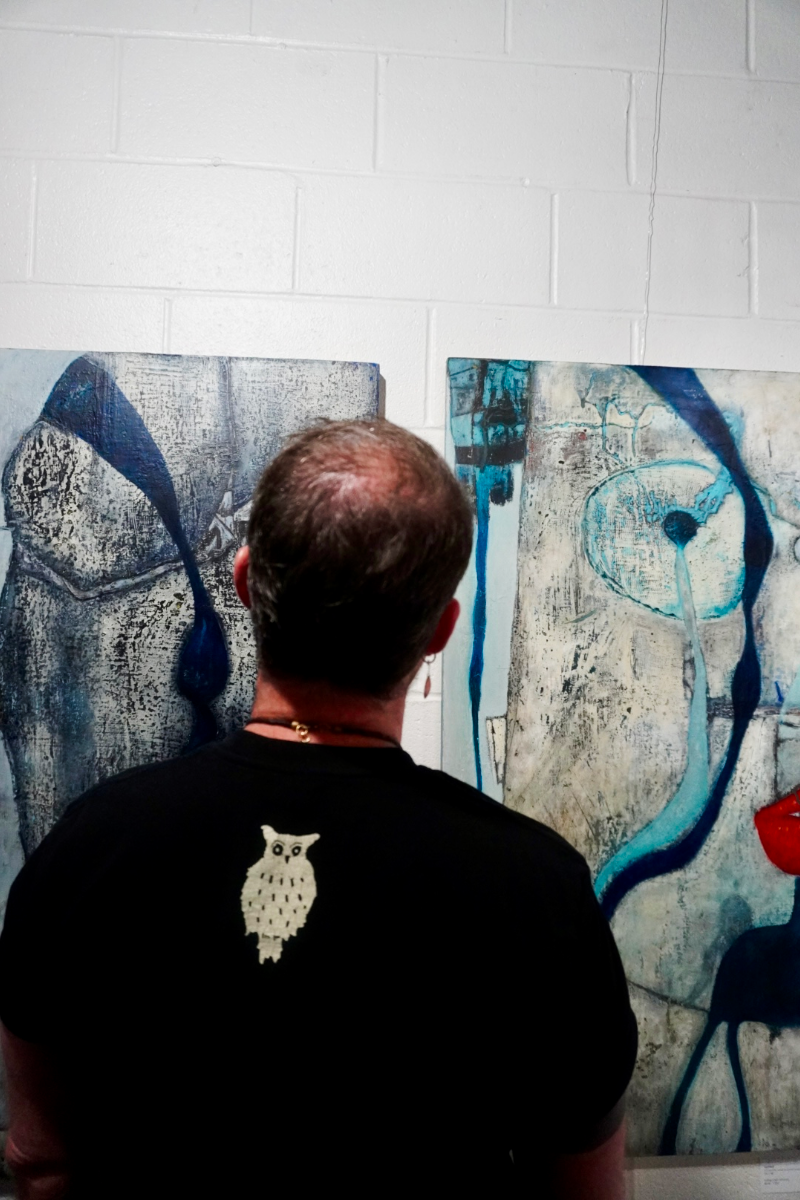
I like to layer my paintings without it making them feel clunky and thick. I'll sand them back with sandpaper or an orbital sander to still give it a thin or a cohesive feel, but most of my pieces have at least anywhere from fifteen to twenty layers. That is because I need that history. I like to work back into layers, and I kind of need that. I need to respond to something.
There's nothing original. I like to think that there is nothing original in this world. Everything comes from something. Each generation is informed by the last.
Even when it comes to music, yes, there can be innovations, but nothing exists in a vacuum. There's nothing original about us, yet we are inherently unique because we have our own personality that no one else has. The information that comes through can be so innovative and different, but still the music’s building blocks are the same.
Creative energy is fascinating. The current is the same, but it’s so interesting to see how each unique personality renders it.
The 413 Joint:
I know we talked about painting, we talked about sculpting, and you do writing. So talk to me about if you're intentionally choosing these different mediums, or how the energy chooses to express itself.
James Emmett:
Not choosing it.
I'm forty seven. I didn't go to college. I went for a month and academia was never an affirming space for me. So I was like, “I'm not paying for this shit.”
I ended up just working and trying to live and ended up in retail, pet specialty retail. From 2012 to 2020, I co-owned a pet boutique in Chicago.
And a few years into owning and operating the boutique I realized and valued that I have a lot of creative energy that wants to express itself. Around 2015, I started making weird things. I carved spoons and made weird tables. I taught myself how to do that. It was the most affirming and exhilarating thing.
Because as a young kid, I tried painting, I tried teaching myself instruments and I always gave up on it despite having a strong desire to be creative. I don't like to be pressured when I'm learning, sometimes classroom environments don't or didn’t work for me. I sometimes wish it did because I think I would have learned a lot more and I’d be more proficient in the things that I want.
I have a huge sense of perfectionism, I always have. So I dropped the things that interested me as a kid because I was like, “I'm not like some prodigy. I'm not automatically good or gifted.”
That process of teaching myself how to do those things with wood was really affirming and corrective and I learned, well I’m still learning that I don’t have to be perfect in order to make things and show up in the world. And so I wanted to do more and more of it.
When we sold in 2020, I got a little bit of change from that, and gave myself some time to teach myself how to do the things I was interested in so I got a studio and taught myself how to make things and it was all woodworking at that time.
In 2022, I started to get into wood sculpture pieces and I wanted to emulate these Napoleon cannons that I had seen at this cemetery that I hung out at a lot. The cemetery was my reprieve from city sounds and concrete and I would just walk through and get some peace of mind there. I had to paint them because they were patina-ed. They had these beautiful green and blue patinas from weatherization dating back to the Civil War.
Now, I love woodworking, but it's also subtractive to my energy in certain ways. And so when I painted these wood sculptures that I turned on my lathe, I think I was painting these cannons the first day for like thirteen hours and it felt like an hour and I was lit up. I was like, “I want to do this. THIS is what I want to do.”
What lit me up was the challenge of trying to understand how to articulate myself through paint on those cannons and to be able to actually, in a second, change the trajectory of that piece in a wild sense felt exhilarating and calming to me, like time stopped. It was just that call and response. That conversation was really, really — I was addicted to it.
That was in 2022. So I started painting as much as I could. I pretty much was like, “I love you, woodworking, but fuck off. I want to do this.”
So in that sort of — yes, it was a choice, it was intentional, but it wasn't a choice as far as I was responding and following what wanted to come out of me.
With writing, I've always written as a way to be able to be with myself, especially through big transitions or changes, as a way to understand myself in the world and my emotional complexities.
Painting and writing started to become this partnership. Not necessarily done at the same time, or writing didn't have to inform a piece and painting didn't have to inform writing. I don't always write for every piece that I make, but in some way, it's a marriage and I don't understand it.
The 413 Joint:
You were talking about found object sculpture and even your painting, and how the fundamentals of life are all energy. Talk to me a little bit more about that.
James Emmett:
When it comes to found object sculpture and even my paintings, and maybe I don't know if it shows up in my writing, wait, yes it does, the fundamentals of life, it's all energy. Whether it's this couch, whether it's you, whether it's a glass of water, that pig that that guy is butchering. It's all, to me, the same energy.
When I think about life that way, it's really easy for me to respect myself and respect other things, whether they be what we perceive as living or not. It's really easy for me to see myself in other forms of existence and when I do it’s easy to give respect to the autonomy that I want and that, I think all life wants. I want my environment to have that energy around me, in the way that I live, in my relationships, in my home and in my studio.
With my sculptures, I like to make them into bodies, something that we perceive as living with a personality. There's something very silly about that for me. And there's also something very true for me in that.
Most of my found object sculptures have a vulva. I usually use copper wire to emulate pubic hair. For me, I'm working out something as far as body sovereignty, my body sovereignty. I’m a queer, trans, AFAB person and I have lived my 47 years in a very violent and dominant patriarchal society that is afraid of bodies that have vulvas. People that have vulvas, to me, have true power and I think the systems and folks who have built our society are afraid of that. And that’s why I see society’s need to dominate and control it. You don’t need to dominate or control something or somebody if you’re secure and not afraid of it or them.
There's something really silly, but yet powerful, about emulating an AFAB body in my found object sculptures.
I like balancing out provocation with levity. With my found object sculptures, it gives me a sense of relief from the boldness, a chance to exhale. And I really just like silly as fuck things because life is absurd. Like what the actual fuck is happening here?
I can take things so seriously sometimes. And I'm also so full of levity about that. I love that balance.
The 413 Joint:
So I’ll talk a little bit about, like you mentioned, talking about vulvas and mentioning that imagery. Personally, I really like the word cunt. I know a lot of people don’t, and some people steer away from it for that reason. But you clearly do not. And I just want to talk about that. Is it intentional? Or is it just a word that you enjoy yourself as well?
James Emmett:
That's a great question. It's a complicated one too. The word is attached to so much emotion, so much anger and violence and depending on the culture it’s mostly used in a derogatory way.
I love the word. To me, it's such a powerful word. Just even the enunciation. You got that C on the front end, that T on the back end. It's just a powerful sounding word, in addition to the emotional charge that's attached to it.
Yes, I love the word and I only love to use the word in affirming ways.
Outside of romantic relationships, I love to use the word in my artwork because it's reclaiming to me the autonomy and the power of that body, my body, and any body that has one. At least that’s the invitation.
There's another part of me that loves to use the word, only in affirming ways for a reaction. I want to antagonize that discomfort that the word conjures.
In my mind — the vulva, cunt, has been exploited and abused in our culture and our society. You're either the Madonna or the whore. No, fuck you. This is my body part. It bleeds. It comes. And at times, it doesn't do any of that. It is my body part. My connection to it has nothing to do with the outside gaze. And my connection to it is a part of my power.
In some parts of our society, looking at a vagina, vulva, cunt, that is not for the male gaze or male pleasure is inciting anger for some reason. And so yeah, fuck you if it makes you angry to see a cunt and to read the word cunt. Good. That should be investigated.
Yes, I really love being provocative in that way. I'm not saying it's revolutionary or anything, and I think a lot of artists play with this, but especially in the art world, the industry of art that I’ve seen, there’s an expectation of palatability even in confrontational work. And the word cunt is not palatable to a lot of folks.
The 413 Joint:
I think when you're a child, you kind of understand the world in a certain way. And then as an adult, you start to lose that. Do you think that you're maybe looking for anything, or is there something that you understood as a child that maybe as an adult you don't really anymore?
James Emmett:
I actually think about that all the time.
There's some work that I've done around that, as far as writing to understand that story.
I think when we're born, we're not fully formed, but yet I think we're probably the truest essence of ourselves. Little by little, depending on our circumstance and the body that we're born into and the environment that we're in, regardless of that, we start to put part of ourselves on the shelf because it's not acceptable or it doesn't fit in, or at least we perceive it that way.
It's also explicitly and implicitly shown to us within the society that we're in. So yeah, you start to forget yourself.
But, I think we’re supposed to change too - there's a part of the cellular body that grows and turns over every seven years. Even in a physical sense, the body that we're born into, the instrument, we continue to be tuned. It's this really interesting thing of losing a part of yourself while also tuning yourself into a more aligned you.
I'm forty seven and I love the process of aging and I always have. The twenties, thank God I'm not in my twenties anymore. That was horrible. Sixteen, no. Every year that I get older, the more and more I like myself.
I think that's why as a kid, I never liked kids. I wanted to be around older people because they had such a strong, at least some of them had such a strong sense of themselves, and, in some ways they didn't care or they gave up on the superficialities that we can get caught up in trying to fit in and survive.
My art practice is the most important relationship that I have in my life, because without that, I don't have a relationship to anything else, especially myself.
The choice to follow this line, this trajectory, it's not the most secure life path as far as security and resources goes. And the fact that I have decided to still continue ways to figure out how I can center it and do it, it's the most meaningful thing to me because in this life that I have perceived that has told me I'm not good enough, that I'm not smart enough, and I'm not capable enough, I prove to myself every time that I show up and finish a piece that I am.
Showing up to my practices lets me break down and compost the sense that my work needs to be perfect to fit in, to be of value - and to just finish a thing and believe in myself that by finishing a thing and then starting the next thing and still staying in it, I'm showing myself my own value and that I do have something to articulate.
That is like heart exploding.
Thank you for reading. You can see more of James Emmett’s work here.